


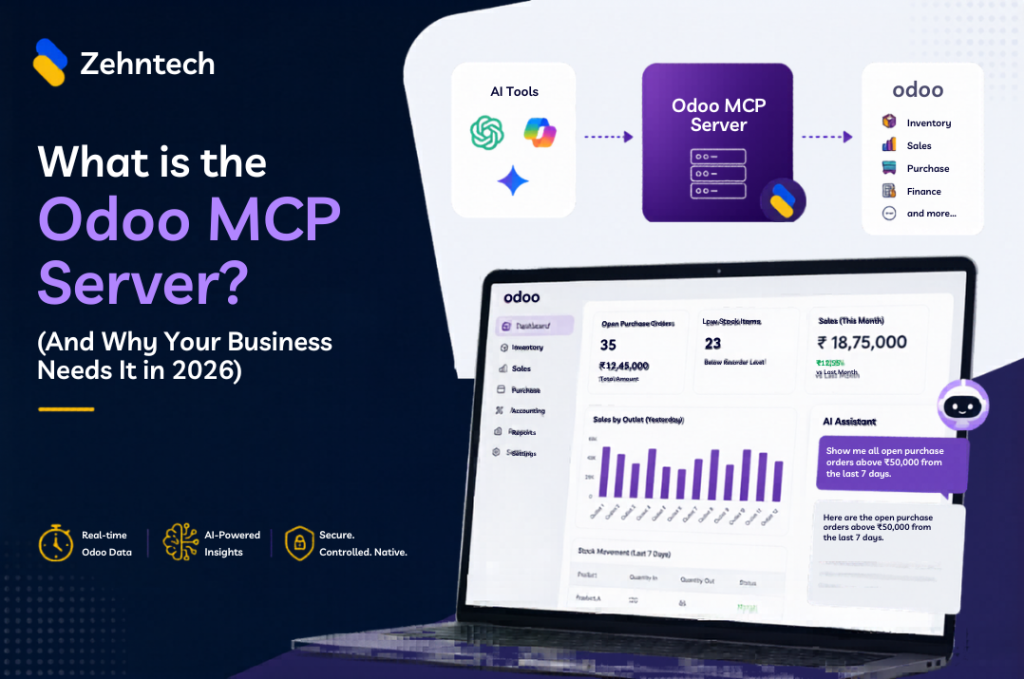

Your team runs Odoo. Your team also uses AI tools — ChatGPT, Copilot, or something similar. But here is the problem: those two systems do not talk to each other. Every time someone needs data from Odoo, a human has to pull it manually, copy it somewhere, and then feed it to the AI tool. That manual step happens dozens of times a day across your operations, finance, and logistics teams.
The Odoo MCP Server eliminates that step entirely.
In this post, we explain exactly what the Odoo MCP Server is, how it works without replacing anything you already have, and what it looks like in practice for manufacturing, retail, and distribution businesses already running Odoo. By the end, you will know whether it is relevant to your business — and what it takes to get started.
The Problem: Your Odoo Data Is Trapped
Most businesses on Odoo reach the same point after 12 to 18 months of use. The ERP is running well. Inventory is tracked. Sales orders are processed. Invoices go out on time. Odoo is doing its job.
But then the questions start getting harder.
“Can you pull the stock movement report for the last 30 days and flag anything below reorder level?” That takes 25 minutes. “Can you compare this month’s purchase orders against last quarter’s averages?” Another 40 minutes. “Can you give me a consolidated view of all outlet sales from yesterday?” Someone spends 45 minutes doing it manually every single morning.
The data is all inside Odoo. The problem is getting it out fast enough to be useful.
At the same time, AI tools have become genuinely capable of answering complex business questions — but only when they can access the right data in real time. Feeding them exported spreadsheets or copy-pasted tables is slow, error-prone, and defeats the purpose.
The gap between your Odoo data and your AI tools is costing your team between 3 and 8 hours every week in manual extraction work alone. The Odoo MCP Server closes that gap.
What is an Odoo MCP Server?
MCP stands for Model Context Protocol. It is an open standard developed to allow AI systems — large language models like GPT-4, Claude, and Gemini — to connect directly to external data sources and business tools in real time.
In plain terms: MCP is the bridge that lets an AI agent read and act on your Odoo data without a human in the middle.
Here is how it works in practice:
- Your AI assistant (whatever tool your team uses) sends a request — “Show me all open purchase orders above ₹50,000 from the last 7 days”
- The Odoo MCP Server receives that request and translates it into a live query against your Odoo database
- The result comes back in seconds — accurate, live, structured
No export. No copy-paste. No manual formatting. The AI gets real Odoo data and gives you a real answer.
What the Odoo MCP Server is not:
- It is not a plugin that changes how Odoo works
- It is not a chatbot bolted onto your ERP
- It is not a replacement for your existing Odoo setup
- It does not require you to move to a new version of Odoo
It sits alongside your current Odoo installation. Your existing workflows, modules, and customisations stay exactly as they are. MCP simply opens a controlled, secure channel between your AI tools and your Odoo data.
3 Real Use Cases: What Odoo MCP Looks Like in Practice
Manufacturing: Inventory Reports in 40 Seconds Instead of 3 Hours
A manufacturing company running Odoo for inventory management had a Monday morning problem. Their operations manager spent 3 hours every week pulling stock reports manually — checking which items were below reorder level, which suppliers needed to be contacted, and which production runs were at risk.
After connecting the Odoo MCP Server, that same report is generated in 40 seconds. The operations manager types one prompt: “Give me all SKUs below reorder level with their last purchase price and preferred supplier.” The AI agent queries live Odoo inventory data and returns a structured, actionable list.
The 3 hours became 40 seconds. The operations manager now uses those 3 hours for supplier negotiation instead.
This works because MCP connects directly to Odoo’s inventory module — stock quants, reorder rules, supplier pricelists — in real time. No stale data. No export lag.
Retail: Consolidated Outlet Data Without the Morning Scramble
A retail chain with 12 outlets across three cities uses Odoo POS at every location. Every morning, their operations manager logged into each outlet’s Odoo instance separately, pulled the previous day’s sales, and built a consolidated view in a spreadsheet. The process took 45 minutes every single day — before the real workday even started.
With the Odoo MCP Server in place, that consolidated view is one prompt away: “Show me yesterday’s sales by outlet, sorted by revenue, with any outlet below ₹40,000 flagged.”
The answer comes back in under 10 seconds across all 12 outlets. The 45-minute morning scramble is gone. The operations manager now starts the day looking at decisions, not at data entry.
Distribution: Automated Purchase Orders, 6 Hours Saved Per Week
A distribution company processes between 80 and 120 purchase orders every week. Their procurement team manually checked stock levels in Odoo, identified items that needed reordering, and created the POs one by one. The process consumed 6 hours per week — every week.
After implementing Odoo MCP Server with an automated reorder workflow, an AI agent monitors stock levels continuously. When any item drops below the defined reorder point in Odoo, the agent automatically creates the draft purchase order, assigns the preferred supplier from Odoo’s vendor pricelists, and flags it for a single human approval.
The procurement team now spends 30 minutes on final approvals instead of 6 hours on manual creation. The other 5.5 hours went back to supplier relationship management and cost negotiation.
What Actually Changes When You Connect AI to Odoo
The difference is not about the technology. It is about where your team spends its time.
Before Odoo MCP:
- Data requests take 25–45 minutes each
- Reports are always slightly out of date by the time they are ready
- AI tools are used for generic tasks — writing, summarising — not for business decisions
- Odoo is valuable but slow to query
After Odoo MCP:
- Data requests take seconds
- Every AI query hits live Odoo data — no lag
- AI tools become genuine decision-support systems
- Odoo becomes the intelligence layer, not just the record-keeping layer
The teams that benefit most immediately are operations (inventory, production scheduling), finance (AP/AR queries, cost analysis), and logistics (order tracking, delivery performance). These are the teams doing the most manual data extraction from Odoo today.
Businesses with 50 to 500 employees on Odoo — where the ERP is well-established but the team is too lean to have dedicated data analysts — see the fastest return. When every manager is also their own analyst, cutting the extraction time from hours to seconds changes how the whole business operates.
How to Get Started with the Odoo MCP Server
Getting started does not require a new Odoo implementation or a version upgrade. If your business is already running Odoo — any version from Odoo 14 onwards — the MCP Server can be connected to your existing setup.
Here is what the implementation process looks like with Zehntech:
Week 1 — Discovery and scoping
We map the 5–10 highest-value data queries your team makes manually every week. These become the first MCP use cases. We also review your current Odoo modules, user permissions, and data structure.
Week 2–3 — MCP Server setup and integration
We deploy the Odoo MCP Server in your environment, configure the connection to your Odoo database, and set up secure access controls. Your team’s existing Odoo user permissions are respected — the AI can only access what each user is authorised to see.
Week 4 — Testing, training, and go-live
We test each use case with your team, run the first real queries against live data, and train your operations and management team on how to use the connected AI tools effectively.
Total implementation time: 3 to 4 weeks for a standard Odoo setup. Businesses with heavy customisations or multi-company configurations may take slightly longer.
Zehntech has implemented Odoo for 600+ businesses across 12 countries and built 108 Odoo apps currently live on the Odoo App Store. Our Odoo services team handles MCP Server implementation as a standalone engagement — you do not need to be a new Zehntech client to get started.
Frequently Asked Questions
Q1: What Odoo versions does the MCP Server support?
The Odoo MCP Server works with Odoo 14, 15, 16, 17, and 18 — both Community and Enterprise editions. If you are on an older version, we assess compatibility during the discovery week and advise on whether a version upgrade would unlock additional MCP capabilities.
Q2: Do I need to change or replace my current Odoo setup?
No. The MCP Server connects alongside your existing Odoo installation. Your current modules, customisations, workflows, and data remain exactly as they are. Nothing in your Odoo setup is modified during the MCP implementation.
Q3: Is the Odoo MCP Server secure?
Yes. The MCP Server respects your existing Odoo user permissions — the AI can only query data that the authenticated user is authorised to access. All connections are encrypted. No Odoo data is stored outside your environment by the MCP layer. Access logs are maintained for audit purposes.
Q4: How long does implementation take?
For a standard Odoo setup, implementation takes 3 to 4 weeks from discovery to go-live. This includes scoping, server setup, integration, testing, and team training. Multi-company or heavily customised setups may require an additional week.
Q5: What does Odoo MCP Server implementation cost?
Implementation cost depends on the complexity of your Odoo setup, the number of use cases scoped, and whether any custom Odoo modules need to be connected. We provide a fixed-price quote after the discovery session. Book a free 30-minute session below to get a scope estimate for your specific setup.
Ready to Connect Your Odoo to AI?
If your team is spending hours every week pulling data out of Odoo manually, the Odoo MCP Server is the most direct fix available in 2026.
You do not need a new ERP. You do not need a data team. You need a controlled bridge between your existing Odoo data and the AI tools your team already uses — and a partner who knows both sides well.
Zehntech has been building on Odoo for 13 years. We have implemented it for manufacturers, retailers, distributors, and service businesses across India, UAE, UK, and USA. The 108 Odoo apps we have published on the App Store are used by businesses in 12 countries.
Book a free 30-minute Odoo MCP strategy session. We will review your current Odoo setup, identify your top 5 manual data extraction tasks, and tell you exactly what MCP implementation would look like for your business — with a timeline and a fixed-price estimate.