


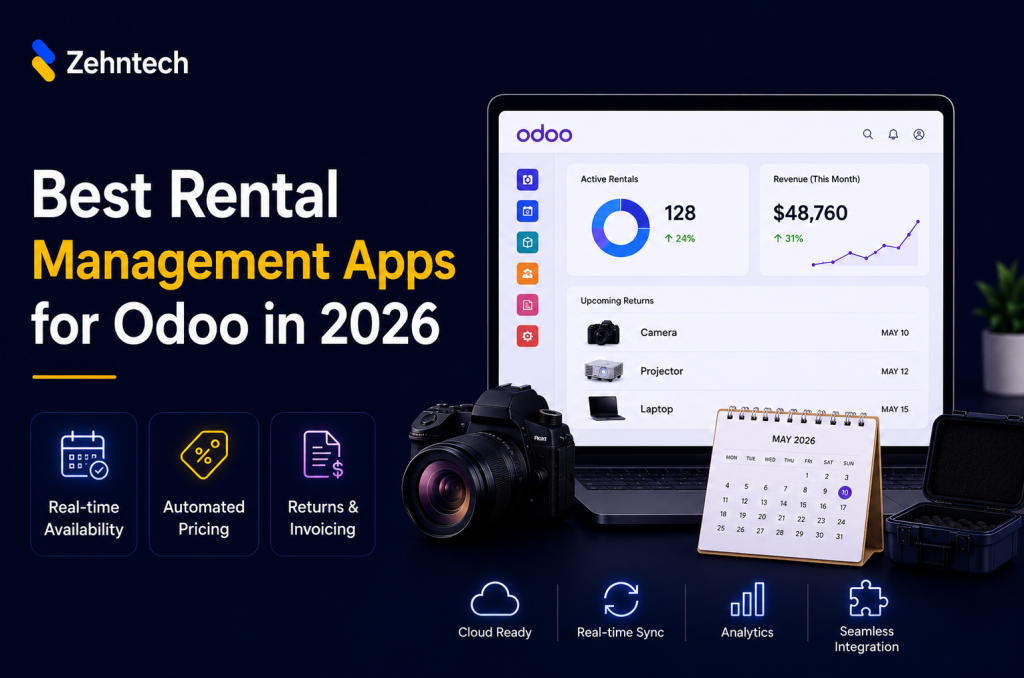

Most Odoo rental businesses hit the same wall. Not a technology wall — a spreadsheet wall. The system that worked fine at 8 items and one staff member starts failing at 20 items and three people. The double booking happens. The damage charge gets missed. The invoice goes out wrong. And then someone builds another spreadsheet to track the mistakes from the first spreadsheet.
The problem is not the people. It is the gap between what Odoo does out of the box and what a rental operation actually needs. Odoo handles sales, inventory, and invoicing at an enterprise level. However, it does not handle rental-specific workflows: real-time availability blocking, duration-based pricing tiers, return condition recording, or rental stock separated from sales stock.
In 2026, Odoo rental businesses have four realistic paths to fill that gap: use Odoo’s native rental module (Enterprise only), install a purpose-built App Store module, commission custom development, or continue managing rental operations in spreadsheets. All four are in active use, and all four have genuine use cases.
This article compares them honestly — on features, cost, setup time, and the scenarios each one is actually suited for.
Why Standard Odoo Is Not Enough for Rental Operations
Odoo is a mature, full-featured ERP. It handles sales orders, inventory, invoicing, purchasing, maintenance, and accounting. However, what it does not include in most deployments is a rental lifecycle workflow.
The core gap
Construction equipment hire companies, event AV rental businesses, medical device lending operations, and tool hire shops all share the same operational requirement: they need to know what is available on a specific date, confirm it without creating a conflict, price it based on how long it is going out, process it when it comes back, and invoice the right amount — including any damage. Standard Odoo covers none of that natively unless you run Enterprise and configure the rental module yourself.
The manual workaround — availability spreadsheet, pricing lookup table, manual invoice step — works up to a point. That point is usually somewhere around 20 items, three staff members, and 10 or more orders per week. Beyond that, the coordination overhead outgrows the capacity of the workaround.
When the spreadsheet breaks down
An equipment hire company managing 40+ items described the breaking point plainly: once two people confirm bookings simultaneously, the spreadsheet cannot prevent a double booking. As a result, the only fix is a system that enforces availability at the moment of confirmation — not a process that relies on people checking before they confirm.
This is part of a wider pattern in how Odoo-powered businesses handle workflow gaps in 2026. The ERP delivers data and core operations; however, specialist workflows — rental, reporting, eCommerce sync — get filled either by purpose-built connectors or expensive custom work. For the broader picture on how teams solve this, how Odoo is transforming business operations in 2026 is worth reading before you decide on an approach.
What to Look For in an Odoo Rental App
Any serious rental management app for Odoo needs to cover six things. Here is what each one does — and what goes wrong when it is missing.
The six capabilities that matter
1. Real-time availability blocking The system enforces availability at the order level, not the memory level. Without it, availability depends on whoever answers the phone remembering to check before confirming. At peak periods — end of week, holidays, event season — that check gets skipped. Consequently, the double booking that follows costs more to resolve than the module ever would.
2. Flexible pricing tiers (automatic) Daily, weekly, and monthly rates are configured per product and the system selects them automatically at order creation based on rental duration. Without automated tier selection, staff members calculate the price manually. As a result, manual pricing creates billing errors proportionally to order volume — and they compound as the business grows.
3. Return processing with condition recording Staff log returns in the rental order with condition notes attached and damage charges applied in the same flow. Without this, damage charges require a separate billing step — and that is where charges consistently get missed. “We forgot to invoice the damage” is one of the most common revenue leaks in rental operations.
4. Integrated invoicing The system generates invoices directly from rental orders, reflecting the actual rental period including extensions. For example, if a customer extends a 7-day rental to 10 days, the invoice updates automatically — it does not require a new document. In contrast, disconnected invoicing creates reconciliation problems between what Sales confirmed and what Finance billed.
5. Inventory sync — rental stock separate from sales stock The system must not make a product available for a sales order while it is committed to a rental order. Without this separation, an item promised to a rental customer gets sold. That is a fulfilment failure caused by a system gap, not a process error.
6. Odoo version support across all deployment types The app must confirm compatibility with v16, v17, v18, and v19, across Odoo Online, Odoo.sh, and On-Premise. A module that only supports one version forces an upgrade decision every time Odoo releases a new major version.
Additionally, support should be included. A module purchase with no installation help adds hidden cost immediately.
How to Install the Zehntech Odoo Rental App
Setup takes under 10 minutes. Here are the exact steps:
Step 1 — Install from the Odoo App Store In Odoo, go to Apps → search zt_rental_app → click Install. No restart required. Installation completes in under a minute.
Step 2 — Mark products as rentable Open any product you want to rent out → check the “Can be Rented” checkbox in the product form. Repeat for each rental item in your catalog.
Step 3 — Configure pricing tiers On each rentable product, open the Rental Pricing tab. Add daily, weekly, and monthly rates. The system then applies the correct tier automatically based on the duration at order creation.
Step 4 — Set up routing rules (optional) If different product categories need different return workflows or condition checklists, configure routing rules in Settings → Rental → Routing Rules. For a basic setup, skip this step initially.
Step 5 — Test with a booking Create a rental order. Select a product, set a rental period, and confirm. The system checks availability in real time. Next, try creating a second conflicting booking on the same product and dates — the system blocks confirmation and highlights the conflict immediately.
That is a working rental system inside Odoo.
Option 1 — Zehntech Odoo Rental App ($99.64 One-Time)
The Zehntech Odoo Rental App covers all six capabilities listed above. Here is what each one looks like in practice.
What the app delivers
Availability blocking: When you create a rental order for a product that already has an active booking in the same period, the system highlights the conflict and blocks confirmation. In other words, the workflow enforces availability checking — it does not depend on the staff member remembering to check.
Flexible pricing tiers: Daily, weekly, and monthly rates are configured per product. At order creation, the system selects and applies the correct tier based on rental duration. For example, a 14-day rental automatically applies the weekly rate for the applicable periods. No manual calculation required.
Return processing: The return flow is built into the rental order. Staff log the return, select a condition, add any damage notes, and apply a damage charge if relevant. Because the invoice updates before dispatch, there is no separate billing step for damage — it is part of the same workflow.
Integrated invoicing: The system creates invoices from rental orders directly, not independently. Therefore, the invoice always reflects the actual rental period, including extensions. If a customer extends a 7-day rental to 10 days, the invoice updates without requiring a new document.
Inventory sync: The Rental App integrates with Odoo Inventory and tracks rental stock and sales stock separately. As a result, a product committed to a rental order is not available for a sales order until the rental closes and the item returns to stock.
Version support: The app supports Odoo v16, v17, v18, and v19 across Odoo Online, Odoo.sh, and On-Premise deployments. All standard Odoo module dependencies — Contacts, Discuss, Inventory, Invoicing, Maintenance, Purchase, Sales — are part of any standard Odoo installation.
Pricing and support
Setup time: Under 10 minutes (see the steps above).
Support: 90 days of free support from Zehntech is included with purchase. Contact: odoo-support@zehntech.com.
Zehntech’s Odoo ERP and CRM implementation experience is behind the app — the same team that builds and maintains Odoo integrations for clients across manufacturing, equipment hire, and events.
Best for: Any Odoo business managing 10 or more rental items, any operation with more than one staff member taking bookings, and any business that needs availability blocking, automated pricing, return processing, and integrated invoicing inside Odoo — without custom development.
Option 2 — Odoo Native Rental Module (Enterprise Only)
Odoo Enterprise includes a native rental module. If your business already runs on Odoo Enterprise, this is worth evaluating before you purchase a third-party app.
What it covers: Basic rental order creation, rental periods, and invoicing. Products can be flagged as rentable. Additionally, it integrates natively with Odoo’s sales and inventory modules.
Where it falls short:
- No automated pricing tiers. The native module does not support duration-based pricing (daily vs weekly vs monthly rates applied automatically). You set a price; however, the system does not select tiers based on duration.
- Limited return condition workflow. The native module does not include a built-in condition recording and damage charge flow. As a result, damage billing requires a manual workaround.
- No rental-vs-sales inventory separation out of the box. Without additional configuration, rental stock and sales stock share the same inventory pool.
- Enterprise-only. If your business runs on Odoo Community, this option is simply not available.
Best for: Odoo Enterprise users with simple rental requirements — basic period tracking and invoicing — who do not need automated pricing tiers or a structured return workflow.
Option 3 — Custom Development ($3,000–$8,000+)
Custom development gives you a rental module built to your exact specification. If your business has availability rules that do not map to a standard calendar, a proprietary pricing model, multi-site scheduling logic, or integration requirements with an external booking platform, then a custom build may be the only approach that covers all of it.
What you get: Complete control over the rental workflow. Every rule, every field, and every report is built to your requirements.
What to factor in before choosing custom development
- Build time. A custom rental module typically takes 6–12 weeks to scope, develop, test, and go live. Throughout that period, you continue managing bookings with your current system.
- Upgrade maintenance. When Odoo releases a major version update, custom modules need review and often updates for compatibility. This is a recurring cost, not a one-time expense — and it compounds across every version upgrade.
- Change requests. Any modification after delivery — for example, a new pricing rule, a new return field, or a new report — requires a return to the development team and a new project scope.
Best for: Rental businesses with highly specific scheduling logic, a proprietary pricing model, or external booking system integration requirements that a standard App Store module cannot accommodate. Justify the cost with specific requirements — not a general preference for a bespoke solution.
Option 4 — Spreadsheets / Manual Tracking ($0 Upfront)
Spreadsheets remain the most common rental tracking method for small operations. The upfront cost is zero, and for a single person managing a small, stable catalog, they work adequately.
What you get: A visible record of current bookings, a structure you control, and no upfront investment.
What it costs over time: Because there is no real-time availability blocking, double bookings are possible whenever two people work from the same document simultaneously. Additionally, manual pricing calculation introduces billing errors proportionally to order volume. Disconnected invoicing means every order requires a separate step to move data from the spreadsheet into Odoo. As a result, overhead grows linearly with volume — there is no efficiency gain as scale increases.
For businesses that have outgrown the spreadsheet stage, Zehntech’s Odoo ERP and CRM implementation team can assess what the right configuration looks like for your specific operation.
Best for: Under 10 rental items, a single person managing all bookings, consistently low order volume.
Side-by-Side Comparison
| Feature | Spreadsheets | Odoo Native (Enterprise) | Zehntech Rental App | Custom Dev |
|---|---|---|---|---|
| Real-time availability blocking | No | Basic | Yes | Depends on spec |
| Flexible pricing tiers (auto) | Manual | No | Automatic | Depends on spec |
| Return processing + damage charge | Manual | Limited | Yes | Depends on spec |
| Integrated invoicing | No | Yes | Yes | Depends on spec |
| Rental vs sales inventory separation | No | Partial | Yes | Depends on spec |
| Native Odoo integration | No | Yes | Yes | Yes |
| Odoo Community support | N/A | No | Yes | Yes |
| Odoo v16, v17, v18, v19 | N/A | v17+ | All 4 versions | Depends on spec |
| Setup time | Immediate | Hours | Under 10 minutes | 6–12 weeks |
| One-time cost | $0 | Included in Enterprise | $99.64 | $3,000–$8,000+ |
| Ongoing cost | Staff time | Enterprise licence fee | $0 | Per version update |
| Support included | None | Odoo support | 90 days free | As contracted |
Which Option Is Right for You?
Choose the Zehntech Rental App if you manage 10 or more rental items, more than one staff member confirms bookings, and you need automated availability, pricing, return processing, and invoicing inside Odoo — on Community or Enterprise, any version. In short, this is the right choice for most growing rental businesses.
Use Odoo native rental if you already run on Enterprise, your rental operation is simple (no multi-tier pricing, no structured return workflow), and you want to stay entirely within the native Odoo toolset.
Continue with spreadsheets if your operation is under 10 items, one person manages all bookings, and volume is low enough that manual coordination has not caused a confirmed double booking or billing error in the last 90 days.
Choose custom development if your rental business has scheduling logic, pricing rules, or integration requirements that go beyond what any standard App Store module provides. Even then, start by confirming those requirements cannot be met by the Zehntech Rental App — because the cost difference is substantial.
How Rental Management Fits Into Your Broader Odoo Setup
The Rental App does not operate in isolation. Instead, it works with Odoo’s existing inventory, invoicing, and sales modules — so once it runs, rental pipeline sits alongside the rest of your operations in one system.
Teams that connect their Odoo data to external reporting tools get even more out of it. For example, sales and operations teams who want to see rental pipeline, equipment utilization, and revenue trends in a single dashboard can build a Power BI report on top of Odoo for real-time visibility without manual exports. The Zehntech Odoo Power BI Connector covers exactly that — including how DirectQuery delivers live data the moment a rental order is confirmed or returned.
Additionally, for teams that need reporting across multiple systems — Odoo, eCommerce, finance, or logistics platforms — Zehntech’s data analytics and visualization services cover the full stack.
Frequently Asked Questions
Q: Which Odoo versions does the Rental App support?
The Zehntech Odoo Rental App supports Odoo v16, v17, v18, and v19. All three deployment types are supported — Odoo Online, Odoo.sh, and On-Premise.
Q: Can the app handle both daily and monthly rental pricing on the same product?
Yes. Multiple pricing tiers can be configured per product — daily, weekly, and monthly rates can all be active simultaneously. The system applies the correct tier at order creation based on the rental duration automatically. No manual calculation required.
Q: What happens if I try to book a product that is already rented?
The system detects the availability conflict in real time and blocks the order from being confirmed. The conflicting booking period is highlighted in the availability calendar. The booking cannot be completed until the conflict is resolved — either by selecting a different product or adjusting the rental period.
Q: Does the Rental App work with Odoo Community edition?
Yes. The app supports both Odoo Community and Enterprise across v16, v17, v18, and v19. Odoo’s native rental module is Enterprise-only — the Zehntech Rental App is available on both editions.
Q: Does the Rental App track rental inventory separately from sales inventory?
Yes. Products marked as rentable are tracked separately from sales stock. A unit committed to a rental order is not counted as available for sale until the rental is closed and the item returned to stock.
Q: How does return processing work — can I record damage charges?
Return processing is built into the rental order workflow. When a customer returns an item, you log the return, select a condition, add damage notes if relevant, and apply a damage charge — all in the same flow. The invoice updates to reflect the charge before it is sent.
Q: How long does setup take?
Under 10 minutes for a standard setup: install from the Odoo App Store, mark products as rentable, configure pricing tiers. 90 days of free support is included if you need help during setup or configuration.
Q: Is custom development worth it for rental management?
For most rental businesses, no. Custom development costs $3,000–$8,000+ and takes 6–12 weeks — only worth it if your pricing rules, scheduling logic, or external integrations cannot be handled by a standard App Store module.
The Practical Bottom Line
Custom Odoo rental module development: $3,000–$8,000+, 6–12 weeks, recurring update costs on every major Odoo version.
The Zehntech Odoo Rental App: $99.64 one-time. Real-time availability blocking, automated pricing tiers, return processing with damage charges, integrated invoicing, rental-vs-sales inventory separation, and 90 days of free support — all included.
For most rental businesses running on Odoo, the math is not complicated.
Install the Odoo Rental App — $99.64 one-time
For teams who want live Odoo data in Power BI dashboards alongside their rental operations — read: How Sales Teams Build Live Odoo Revenue Dashboards in Power BI
-
Why Standard Odoo Is Not Enough for Rental Operations
- The core gap
- When the spreadsheet breaks down
- What to Look For in an Odoo Rental App
- The six capabilities that matter
- How to Install the Zehntech Odoo Rental App
- Option 1 — Zehntech Odoo Rental App ($99.64 One-Time)
- What the app delivers
- Pricing and support
- Option 2 — Odoo Native Rental Module (Enterprise Only)
- Option 3 — Custom Development ($3,000–$8,000+)
- What to factor in before choosing custom development
- Option 4 — Spreadsheets / Manual Tracking ($0 Upfront)
- Side-by-Side Comparison
- Which Option Is Right for You?
- How Rental Management Fits Into Your Broader Odoo Setup
- Frequently Asked Questions
- The Practical Bottom Line