Join us at GITEX 2025! Discover our solutions at Hall 4, Booth H-30 Schedule a Meeting Today.
Automate Marketing Initiatives with Salesforce Marketing Cloud Learn More
Join us at GITEX 2024! Discover our solutions at Hall 4, Booth H-30 Book your live demo today.

How to Integrate BIRT into a Web Application?

BIRT, Business Intelligence Reporting Tool has been a cornerstone for the businesses in creating intelligible reports for data analytics and subsequent decision making to drive better and enhanced business performance. However, it is not enough for businesses to get started with BIRT. While in theory, it seems an easy way out to just get started with BIRT and start running reports using its templates, it does not work that way practically. For leveraging the best capabilities of BIRT when working over a practical approach, it becomes important that the tool is well integrated with your web applications so that the functions are synced and you can work them out more intelligibly.

But how to integrate BIRT into your Web Application? This article is just the solution you are looking for.

Steps to Integrate BIRT into Your Web Application

Add Dependencies

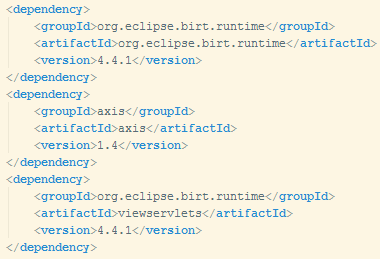
The first step to BIRT integration is adding dependencies. This means that you have to connect the application with the existing libraries using a project builder such as Maven. Below is the code that you shall need to run for the purpose:

image4 1 1


After you have run the code, the dependency is created as per your requirements and you are good to move further with the BIRT integration process which involves configuration procedure.

Deployment Descriptor Configuration

As the dependencies are created, there is the information required to be filled in and configured with the deployment of BIRT server. There is a web.xml file where all information has to be added and configured.

Below is the list of commands, codes, and information that is required.

1. Setting the location for the working folder in BIRT, that is, the folder that shall carry all the reports.

birtimage10

2. Setting flag value to determine the location of the reports. Generally, the reports are available only from the working directory and the default flag value is TRUE.

birtimage8

3. Specifying the parameters to set up work with the URL addresses of the reports. There are several values for this which depend on the nature of the report URL.

birtimage9

4. Defining configuration file location.

Birtimage16

5. Defining the areas where the print function is available, whether only on the client-side or on the server-side as well. By default the function is ON.

birtimage17

6. Setting flag to determine if compelling optimization for the browser in HTML is enabled or not. The default value is TRUE.

birtimage1

7. Specifying Class names for the reports.

birtimage12

8. Setting Servelet Context and HTTPSessionListener.


birtimage3

birtimage5

9. Registering and Configuring ViewerServelet and Engine Servelet.
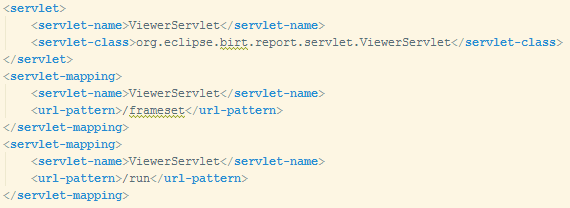
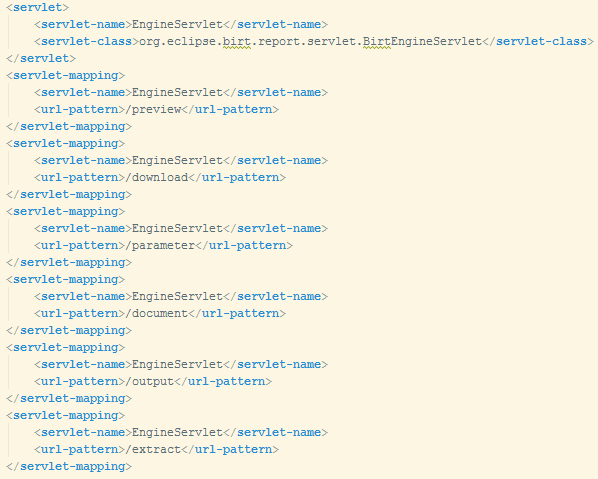
birtimage15

birtimage14

Once done with all these things, you are finished with the configurations. All you have to do now is connect the program files and add a report template to the project. With that, you shall be finished with the BIRT integration.

Connecting Program Files

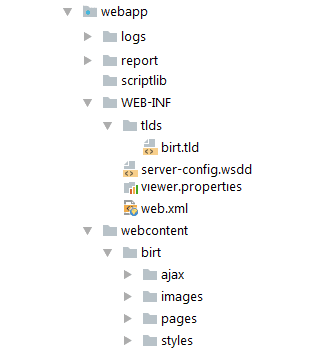
For connecting the program files, you have to start with downloading certain archives which are namely webcontent.zip and programfiles.zip.

After this download, you can start creating your individual folders and then create a tlds directory. After that, you move on to putting files from the programfiles.zip archive in the web application as follows:

birt.tld into /webapp/WEB-INF/tlds
erver-config.wsdd files and viewer.properties into /webapp/WEB-INF

Once done, this is how the content in the folders and files shall appear:
birtimage6

Adding Reports

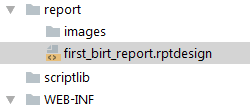
Now, BIRT components are added and integrated into the web application so that the reports start displaying. You just have to put the report templates into the /webapp/report folder.

Once done, it will look like this:
birtimage11

After this, you can also put a link to your report in the web application and the entire report management becomes very easy.

There is yet one last thing you ought to do, that is, run the application. Do it with the following code and command.
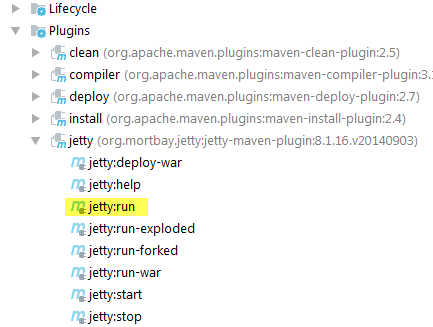
birtimage7

After you run the application, your report is available to you over it.

A place for big ideas.

Reimagine organizational performance while delivering a delightful experience through optimized operations.

Conclusion

So, this is how BIRT integration with WordPress is done to make things easier for a practical approach and help you best leverage the tool. Hope this helps!

Top Stories

Odoo ERP Implementation (1)
How Indian MSMEs Can Use Budget 2026 Subsidies to Fund Their Odoo ERP Implementation
India’s Union Budget 2026–27 has sent a strong signal to small and medium enterprises: technology adoption is no longer optional — it is strategic. With a ₹10,000 crore MSME-focused fund, a ₹2,000 crore top-up for the Self-Reliant India Fund, and renewed emphasis on digital modernization, the government is actively encouraging
Sap’s critical 9.9 vulnerability
SAP’s Critical 9.9 Vulnerability: Why Mid-Market Companies Are Rethinking Their ERP Security
Resource Planning (ERP) systems sit at the center of business operations. When a vulnerability with a CVSS score of 9.9 is disclosed in SAP environments, it immediately draws attention — not because of hype, but because of operational risk. During the February 2026 SAP Security Patch Day, multiple high-severity security notes were released, including one
Odoo
Odoo v14 End of Life: What the October 2026 Kill Date Means for Your Business
If you’re still running your business on Odoo v14, you now have a hard stop on the calendar 31 October 2026. That’s when Odoo v14 will reach the end of life on Odoo.sh, and any database still on that version will be blocked from normal use. It’s not just a technical detail it’s a real business continuity risk if you ignore
10 Proven Tips for Successful Odoo Module Customization
Odoo is famous for its customizable nature. Businesses from around the world choose Odoo because of its scalability and modality. Regardless of the business size, Odoo can cater to the unique and diverse needs of any company. Odoo has proven its capacity and robust quality in terms of helping businesses
How Odoo is Transforming Traditional Education with E Learning
How Odoo is Transforming Traditional Education with E-Learning?
Does your school need to centralize data to easily access and share information between applications? Odoo provides an ERP system that can do so. Using multiple software applications for every department can be dragging. With Odoo, you can systematize your operations for efficiency, user-friendly navigation, uniform cross-functional practice, and increased
How Can Odoo Module Customization Revolutionize Your Purchase Management Workflow
How Can Odoo Module Customization Revolutionize Your Purchase Management Workflow?
Odoo ERP’s modules are engineered with a robust structure to drive efficiency across your entire organization. Each module is specifically designed to address distinct business functions, from finance and inventory to sales, marketing, and purchase management. This tailored approach ensures that every part of your company has the tools it needs to excel. The true power of

          Success!!

          Keep an eye on your inbox for the PDF, it's on its way!

          If you don't see it in your inbox, don't forget to give your junk folder a quick peek. Just in case.


              You have successfully subscribed to the newsletter

              There was an error while trying to send your request. Please try again.

              Zehntech will use the information you provide on this form to be in touch with you and to provide updates and marketing.