


Join us at GITEX 2025! Discover our solutions at Hall 4, Booth H-30 Schedule a Meeting Today.
Automate Marketing Initiatives with Salesforce Marketing Cloud Learn More
Join us at GITEX 2024! Discover our solutions at Hall 4, Booth H-30 Book your live demo today.

How LMS Adoption Helped Businesses to Grow in Amid Pandemic

Known as the COVID-19 virus, this novel Coronavirus has caused millions of deaths across the globe. Because of disruptions in the workplace, increased stress associated with COVID-19, and reduced hours, there has been job loss throughout the industries.

Seeing a rising trend in the covid cases during the pandemic, companies have turned to The Learning Management Systems (LMS) to prevent the damaging effects. It has helped companies change the way they have been conducting various activities and has enabled efficiency even when employees are working remotely.

LMS Contributed to Business’ Growth Amid Pandemic

LMS are software applications that provide the framework needed to handle all aspects of the training process. It is primarily used to store, deliver, and track the content of the training.

Learning Management System is so important because, through LMS, objectives are identified and assessed, progress toward achieving them is tracked, and all the stakeholders are notified of progress. Moreover, a Learning Management System can deliver content and also perform tasks including onboarding, compliance, and analysis of skills gaps.

Having a wide range of technical importance and in light of the global health crisis that has rampaged the industrial chains across the world, here are a few ways a learning management system has proven beneficial to businesses.

LMS Has Enabled Staff To Work And Train Remotely

Since the COVID-19 outbreak, providing employees with the option of working remotely became increasingly important for companies. Companies adhered to government guidelines that encouraged employees to work remotely as much as possible, and as a result, many companies allowed their workers to work remotely.

Training has typically been provided through learning management systems by enabling employers to create, distribute, track, and report on employee training.

Additionally, LMS encouraged remote work by adding tools like video conferencing and synchronous real-time chat, which allowed workers to remain productive and up to date with training.

Workplaces Have Been Able To Maintain Collective Engagement In Their Activities

During this period of physical and emotional isolation, fully-featured LMS has been offering social learning tools that kept encouraging a sense of community, and togetherness amongst the employees with the organization. There have been some noteworthy LMS features and tools that have enabled remote training and work amid the entire movements have been banned and lockdowns have constantly been imposed.

The LMS also offered learners the chance to gain guidance and advice about training or work projects by engaging them in various online communities or forums. This kept organizations/platforms in sync with the customers and the business kept attracting more customers even when movements were restricted.

Furthermore, the need for workforce unification became more important than ever since many employees had to work in remote areas which made it immensely difficult to handle the day-to-day tasks and work which affected productivity and morale until the LMS system was not adopted by the suffering companies.

Employers adopted a learning management system to promote collaboration and promote workers’ connection to the company and each other which helped the business flourish.

Online Learning Guaranteed Efficiency

Compared to learning in a conducive environment, learning remotely has definitely been a different experience. Students and instructors were distracted by learning at home, resulting in destruction and lack of focus. LMSs met the challenge by providing tools and features that ensured learning activities and experiences were vibrant despite the pandemic that helped companies sustain their customers/learners.

Administrators uploaded PowerPoint presentations, distributed learning material, posted reminders, delegated assignments, and administered tests. Thus, compared to traditional learning methods, LMS proved to be considerably more effective. Several features were integrated into the platform, including videos, document sharing, forums, and live conferences, etc. to bring such a holistic result for the companies and the customers. LMS helped companies keep the materials in a single place that made management and access very easy for both the company and the customers.

Personalized The Online Learning Experience

Companies were able to customize the online learning experience with Learning Management Systems. Learning could be done on the job at any time and from anywhere, including the home. Flexible learning and training options were provided that enabled learners/ employees to learn and continue training where ever they wanted. The students and employees could choose the date and device they wanted to use when taking the online course and training. Administrators also had the flexibility of choosing the exact ways in which content would be delivered to the learners as they incorporated LMS in their businesses. By doing this, the eLearning experience was customized as well as personalized that made learning easier than ever.

A place for big ideas.

Reimagine organizational performance while delivering a delightful experience through optimized operations.

Conclusion

COVID-19 has thrown a lot of curveballs at businesses that were doing well just before COVID-19 cases surged and lockdowns were imposed. It was through the implementation of digital tools, such as a learning management system, that organizations emerged stronger and more successful from this global health crisis.

In times of severe downturn, these companies were able to sustain themselves even when other companies were shutting down. Therefore, LMS has played a very crucial role in the success of various businesses during the pandemic.

Top Stories

Step-by-step guide to setting up Manufacturing Gantt Scheduling in Odoo — Zehntech
How to Set Up Manufacturing Gantt Scheduling in Odoo — Step-by-Step
Manual exports can work — for very small teams with low-frequency reporting needs. If your team reports monthly, uses a single Odoo module, and has an analyst with spare time, a manual export process is adequate. But for most Odoo teams reporting weekly or more frequently, there is a measurable
Odoo shopify connector
Best Shopify Odoo Connectors in 2026 — What Actually Works
If you are looking for a Shopify Odoo connector in 2026, you have three realistic paths: install a dedicated connector from the Odoo App Store, commission custom development, or continue running manual data entry between platforms. Each option has a legitimate use case. This article compares all three honestly —
Odoo shopify connector
Odoo Shopify Connector vs. Manual Data Entry — Which Is Right for Your Business?
Manual exports can work — for very small teams with low-frequency reporting needs. If your team reports monthly, uses a single Odoo module, and has an analyst with spare time, a manual export process is adequate. But for most Odoo teams reporting weekly or more frequently, there is a measurable
Odoo Power BI connector
Odoo Power BI Connector vs. Manual Data Exports: Which Is Right for Your Business?
Manual exports can work — for very small teams with low-frequency reporting needs. If your team reports monthly, uses a single Odoo module, and has an analyst with spare time, a manual export process is adequate. But for most Odoo teams reporting weekly or more frequently, there is a measurable
Odoo Power BI connector
How to Connect Odoo to Power BI — Complete Setup Guide
Connecting Odoo to Power BI does not require a consultant or a custom development project. The Zehntech Odoo Power BI Connector handles the hard parts — authentication, schema management, scheduled sync — so you can focus on building dashboards.This guide is for Odoo administrators and IT implementers connecting Odoo to
Odoo Shopify connector
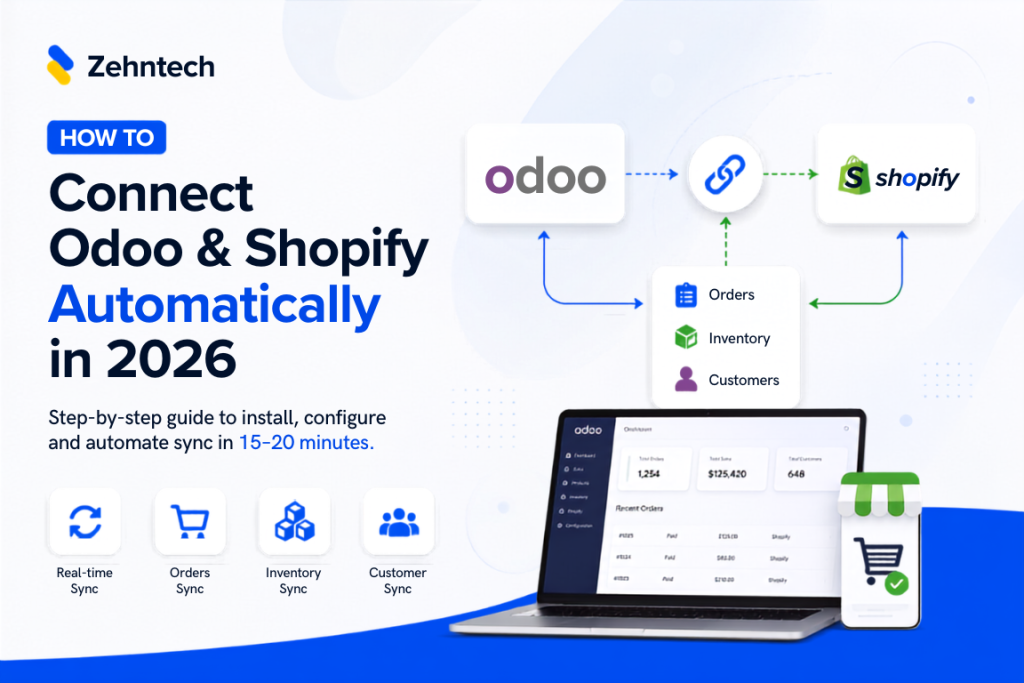
How to Connect Shopify to Odoo — Complete Setup Guide
Connecting Shopify to Odoo does not require custom development or a system integrator. The Zehntech Odoo Shopify Connector handles the authentication, data mapping, and sync logic — so you can focus on configuring which data to move, not how to move it.This guide is for Odoo administrators and IT implementers

          Success!!

          Keep an eye on your inbox for the PDF, it's on its way!

          If you don't see it in your inbox, don't forget to give your junk folder a quick peek. Just in case.


              You have successfully subscribed to the newsletter

              There was an error while trying to send your request. Please try again.

              Zehntech will use the information you provide on this form to be in touch with you and to provide updates and marketing.