


Automate Marketing Initiatives with Salesforce Marketing Cloud Learn More

Learning Management System Implementation Fails – What Not to Do?

Learning Management Systems and e-learning solutions have come as a great way for businesses to promote skill and professional development in their employees and staff. With the use of these solutions, most organizations have been able to achieve a competitive edge and revenue growth with increased levels of employee productivity. However, there are still many organizations that struggle with Learning Management System Implementation and are unable to see any significant benefit coming to them from it.

Where could the problem be? Where are you going wrong? Is there anything that you must not do when carrying out an LMS implementation? Well, here is a list of seven things you must never do when carrying out LMS implementation to prevent e-learning failures.

Reasons for LMS Implementation Fails

Choosing an LMS that Cannot be Integrated With Your Other Systems

You are implementing an LMS in your organization primarily to support the training of your employees to streamline the organizational process and enhance productivity in workflows. This will be helpful only if the LMS is able to integrate and work with the organizational systems and processes for which you aim to train your employees. So, choosing an LMS which does not support system integrations will come as a big LMS implementation failure.

What you need to do is pay close attention to all your systems, processes, and workflows and make sure that all the interface sync with each other.

Lacking on Team Work

Most often, the process of LMS implementation is planned to be carried out without the constitution of a proper team. This can be the biggest mistake. LMS implementation is never a one man show. It involves many aspects and you need a well-built team of experts to carry out the implementation successfully. The best bet is to hire the services of LMS implementation experts so that the solution can be incorporated into your organizational setting professionally and successfully.

Keeping the Interface Complex

Complexity in any system or software is never favorable and will come as a big loophole. Many times, it so happens that the LMS is designed to be too complex for the sake of having advanced features and functionalities in it. The results, the users are not able to understand the system and the entire implementation fails.

A better approach is to design an easier system with essential, advanced, yet easy to understand and limited functionalities with the ability to scale and expand at a later stage. This way you can drip feed the features into the system and make sure that the LMS does not get complex for use and understanding at any point in time.

Lack of Support

This is a big issue with LMS implementation and can lead to a huge failure. LMS is a software and software need constant support from IT staff. But most of the times, organizations face difficulty in getting that support for their LMS after implementation. This creates problems with the functioning of the LMS and eventually the implementation fails.

A simple solution is to look for LMS vendors that provide effective and efficient support services after the implementation to ensure that the software is well-maintained and functioning smoothly

Over Customization

Customization is a great thing to add to the personalized experiences on the LMS, however overdoing it will not work out well for your LMS implementation. Over customization will lead to the system becoming complex and slow which can hamper the good experiences from the LMS.

You need to make sure that you are doing the customizations smartly and not adding up to the complexity of your platform with them.

Lack of Content and Training

Content and Training are an essential part of LMS implementation. But many times the LMS lack on the necessary training which lead to failures.

You need to keep a note that the LMS shall be only as good as the training and content contained in it and make sure that it is on point. It is only through that the LMS will work out well for you.

A place for big ideas.

Reimagine organizational performance while delivering a delightful experience through optimized operations.

High Expectation

Expectations never cease and this can come as a major issue. It is a possibility that the LMS is working really well as per its configuration and interface, but you have kept your expectations high. At this point, you either need to lower down your expectations or you need to look into ways that could help meet those high expectations.

This is a small list explaining where things go wrong with learning management system implementation. Make sure to not make these mistakes so that you never have your LMS fail.

Top Stories

The Complete Guide to Odoo in 2026
The Complete Guide to Odoo in 2026: Implementation, Customisation, Integration, Migration and Cost
What Odoo actually is Odoo is a suite of business applications built on a shared database — CRM, sales, inventory, manufacturing, accounting, HR, website, point of sale, and several dozen more. The applications are modular. You switch on the ones you need and leave the rest off. The architectural point
How to Connect WooCommerce to Odoo
How to Connect WooCommerce to Odoo — Complete Setup Guide
Connecting WooCommerce to Odoo does not require a developer, a middleware tool, or weeks of implementation. The Zehntech Odoo WooCommerce Connector gives you real-time bi-directional sync between your WooCommerce store and your Odoo backend — set up in under 15 minutes. This guide is for Odoo administrators, eCommerce operations managers,
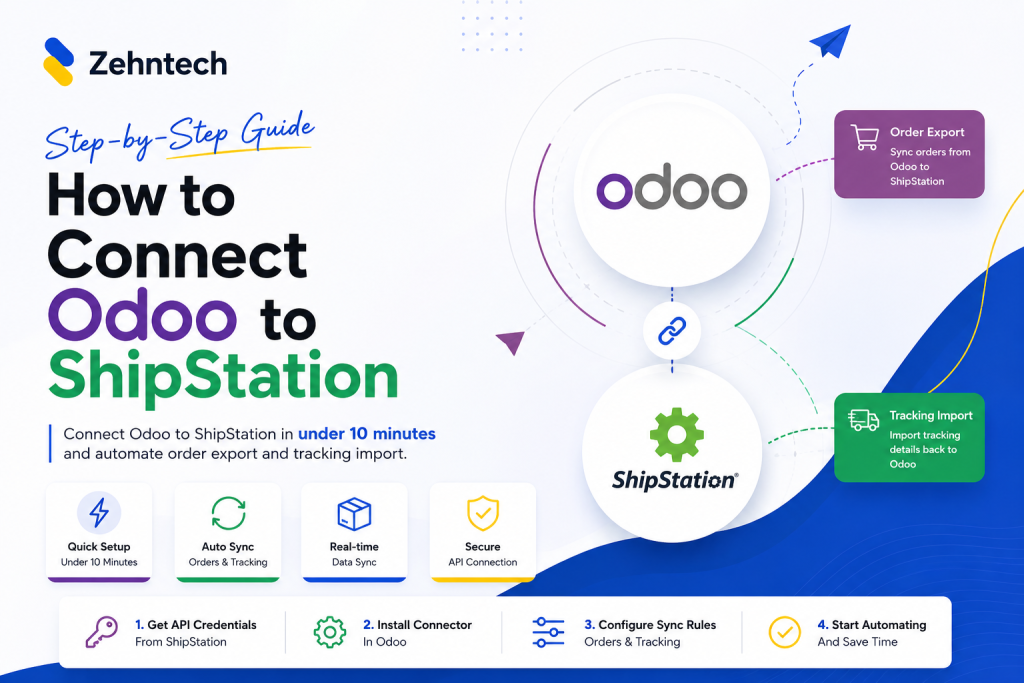
How to Connect Odoo to ShipStation — Step by Step Setup Guide
How to Connect Odoo to ShipStation A Step-by-Step Setup Guide
This guide walks you through connecting Odoo to ShipStation using the Zehntech Odoo ShipStation Connector — from generating your API credentials in ShipStation to your first automated order push and tracking import. Most setups take under 10 minutes. Prerequisites Before you begin: Odoo version: v17, v18 or v19 (Online, Odoo.sh
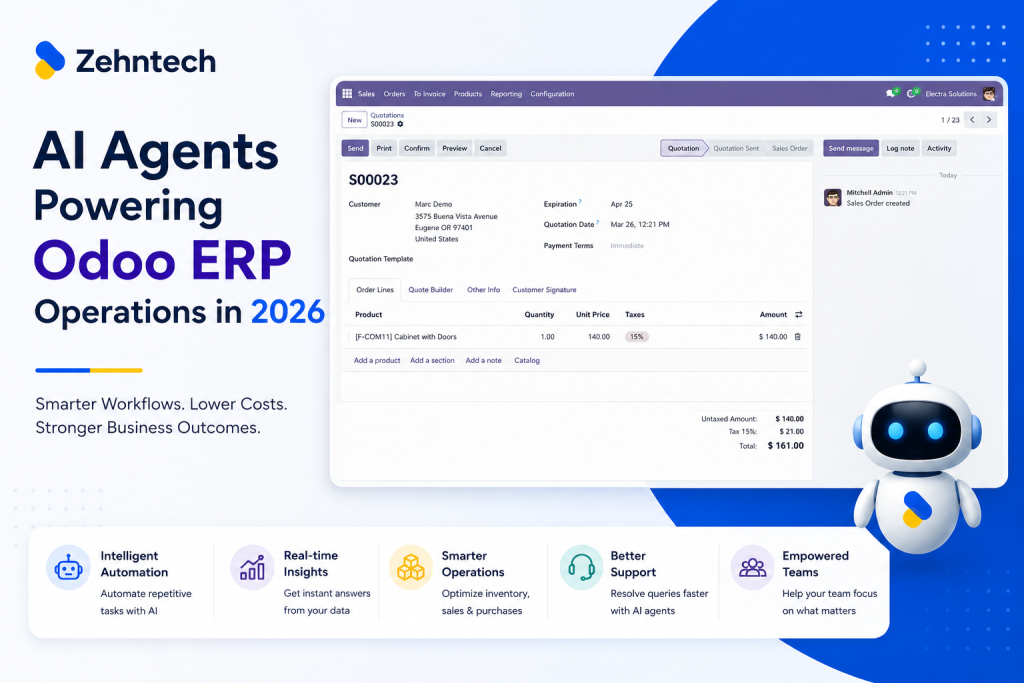
AI Agents Are Transforming Odoo ERP Operations in 2026
How AI Agents Are Transforming Odoo ERP Operations in 2026
Most ERP systems already hold the information needed to make better decisions. The problem is the work between the data and the decision: opening several modules, filtering records, exporting spreadsheets, comparing numbers and then updating Odoo manually. AI agents are beginning to remove that gap. Unlike a chatbot that only
Connect Odoo & Shopify Automatically in 2026
How to Connect Odoo and Shopify Automatically (2026 Guide)
If you're running Shopify for your storefront and Odoo for everything behind it — inventory, accounting, fulfillment — you already know the two don't talk to each other out of the box. This guide walks through exactly how to connect them so orders, stock, and customer data sync automatically, with
Odoo Hubspot Connector
How to connect hubSpot to odoo a step-by-step setup guide
This guide walks you through connecting HubSpot to Odoo using the Zehntech Odoo HubSpot Connector from generating your API key in HubSpot to your first live sync. Most teams complete this in under 10 minutes. Prerequisites Before you begin: Odoo version: v16, v17, v18 or v19 (Online, Odoo.sh or On-Premise)

          Success!!

          Keep an eye on your inbox for the PDF, it's on its way!

          If you don't see it in your inbox, don't forget to give your junk folder a quick peek. Just in case.


              You have successfully subscribed to the newsletter

              There was an error while trying to send your request. Please try again.

              Zehntech will use the information you provide on this form to be in touch with you and to provide updates and marketing.