


Automate Marketing Initiatives with Salesforce Marketing Cloud Learn More

Things You Need to Consider When Integrating Epicor ERP with Magento

When you have an e-commerce store, you have a vast database to handle. There are product details, order details, customer details, and other media that you need to manage. And for all of this, you need a dedicated enterprise management system. But it can be hectic toggling between two different platforms. So, it is always preferable to integrate your ERP system with your e-commerce website. Such integration has enormous benefits, which we have discussed in one of our blogs. And looking into that benefit, you must surely be curious to know how to perform Magento Epicor Integration. But before you actually do that, there are some essential things that you need to take care of.

Magento Development is tricky, and so is maintaining an ERP system. And bringing both these systems together… well, that can be all the trickier and more challenging task. But, there are some things that you can do to make it easier. Here are some of the factors you must pay heed to when you are looking out for integrating your Epicor ERP with your Magento e-commerce website.

Factors to Keep in Mind During Magento Epicor Integration

Flexibility for Integration

Both Magento and Epicor are highly flexible platforms, and you shall never face any restrictions as regards the development, customization, or integration between these platforms. However, you still need to check the viability of the integration for your source code. You do not want to put in lots of effort configuring your base code or find that the source code is restricting the sharing of some very essential data fields. So, before you perform the integration, it is best that you check the flexibility of the integration and assure yourself that the integration is entirely amenable for the systems and codes that you are using. Also, you might get yourself some more systems in the later course that you might want to integrate with the existing platform. So, also make sure that the platform is flexible for it and allows that.

The Team Performing the Job

The integration of software is an extremely tricky job. It is not just some lines of code. It would be best if you took a deeper dive, get into the depths, have a complete understanding of the systems that you are working on. To put it in clear words, the integration of two or more software together is not a code but a complete software solution. So, it would be best if you had an expert team to come with that solution. Look for a team with highly qualified and experienced professionals who are well versed in every aspect of both the platforms. The team working on your Magento Epicor Integration project must be knowing every nook and corner of the working of that software, their feature, and the best course of action they can take. Take your time finding your team, screen for companies providing Magento Development Services, discuss your project with them, and only after you are satisfied that you have found someone well-suited to your needs and requirements proceeds further with your project.

Customized Solutions

There are many plugins that can offer for Magento Epicor Integration. But these are not the solution that you are actually looking for. The plugins can solve your purpose to some extent, but you are sure to face limitations with them in the long run. Different businesses have different needs. Thus, a generalized plugin is, for sure, not the best course of action. It would be best if you had something that is better suited to meet your business needs. And only a good, customized solution can do that. So, look for an integration that is totally customized as per your business model and caters to all the needs and requirements of your business.

A place for big ideas.

Reimagine organizational performance while delivering a delightful experience through optimized operations.

Conclusion

Magento Epicor Integration is a valuable service you will get for your business. It has the capability to scale your business and bring you higher profitability and scalability by providing the flexibility to manage your entire e-commerce business with a single source. With the integration, you have your whole ERP system synced with your e-commerce platform. So, you are essentially saved from toggling between them through the manual entries of data from one platform into the other because the platforms will simply pull the data between each other. An update on one platform will lead to an automatic update on the other platform. So, you have your time saved and energy saved. Besides this, there are other significant benefits of the Magento Epicor Integration that you absolutely do not want to miss out on. So, get the integration for your e-commerce business and get it in the best ways by keeping all the above essential factors in your mind so that you may take your e-commerce business up a notch.

Top Stories

The Complete Guide to Odoo in 2026
The Complete Guide to Odoo in 2026: Implementation, Customisation, Integration, Migration and Cost
What Odoo actually is Odoo is a suite of business applications built on a shared database — CRM, sales, inventory, manufacturing, accounting, HR, website, point of sale, and several dozen more. The applications are modular. You switch on the ones you need and leave the rest off. The architectural point
How to Connect WooCommerce to Odoo
How to Connect WooCommerce to Odoo — Complete Setup Guide
Connecting WooCommerce to Odoo does not require a developer, a middleware tool, or weeks of implementation. The Zehntech Odoo WooCommerce Connector gives you real-time bi-directional sync between your WooCommerce store and your Odoo backend — set up in under 15 minutes. This guide is for Odoo administrators, eCommerce operations managers,
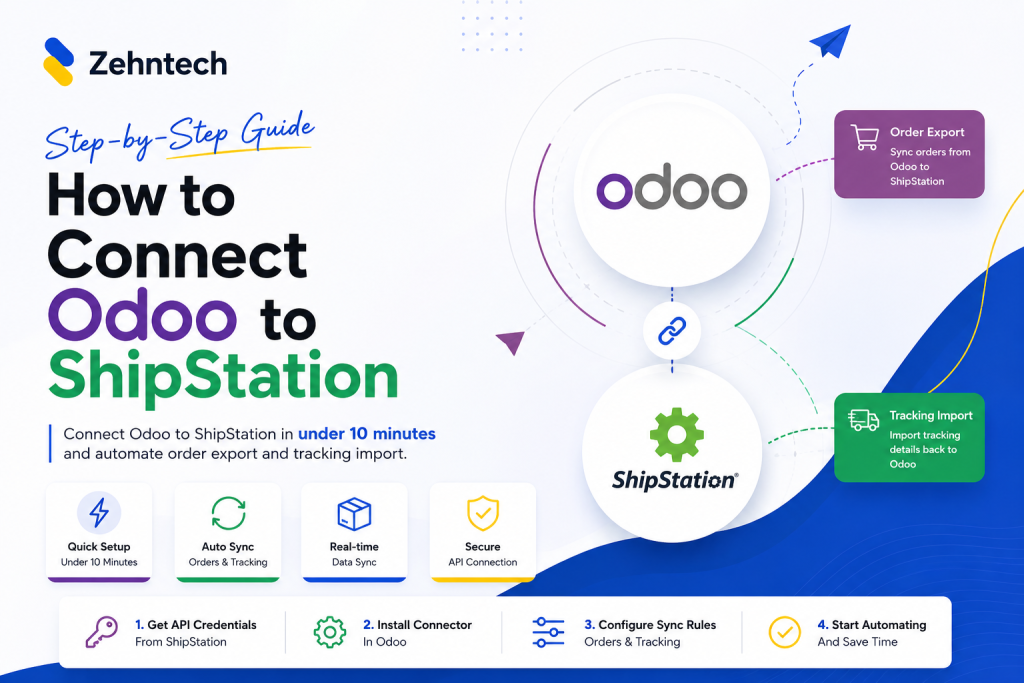
How to Connect Odoo to ShipStation — Step by Step Setup Guide
How to Connect Odoo to ShipStation A Step-by-Step Setup Guide
This guide walks you through connecting Odoo to ShipStation using the Zehntech Odoo ShipStation Connector — from generating your API credentials in ShipStation to your first automated order push and tracking import. Most setups take under 10 minutes. Prerequisites Before you begin: Odoo version: v17, v18 or v19 (Online, Odoo.sh
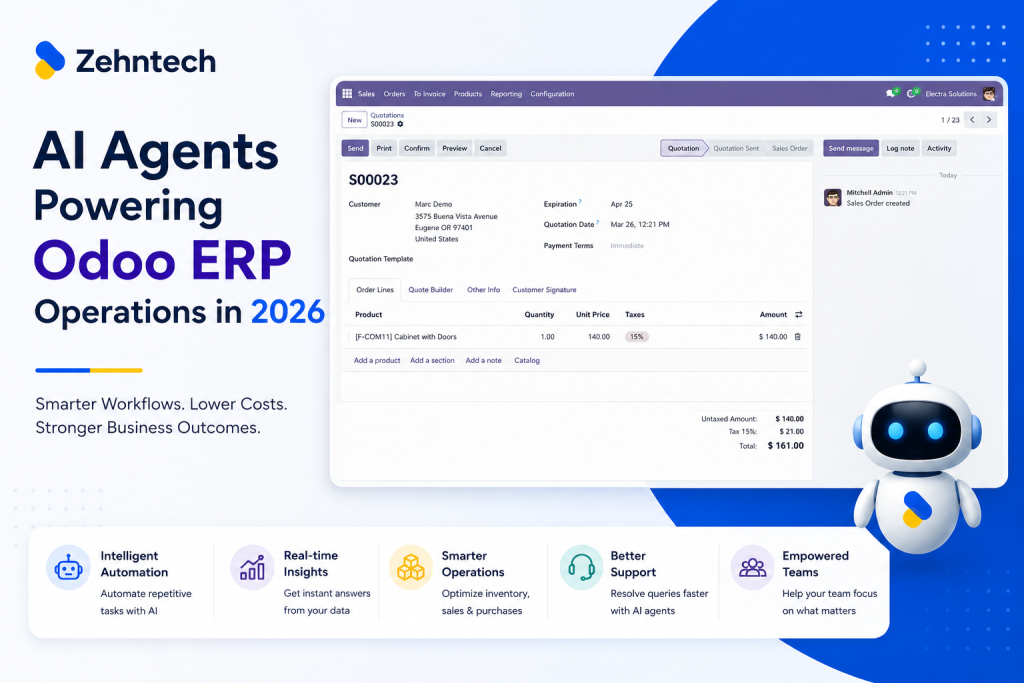
AI Agents Are Transforming Odoo ERP Operations in 2026
How AI Agents Are Transforming Odoo ERP Operations in 2026
Most ERP systems already hold the information needed to make better decisions. The problem is the work between the data and the decision: opening several modules, filtering records, exporting spreadsheets, comparing numbers and then updating Odoo manually. AI agents are beginning to remove that gap. Unlike a chatbot that only
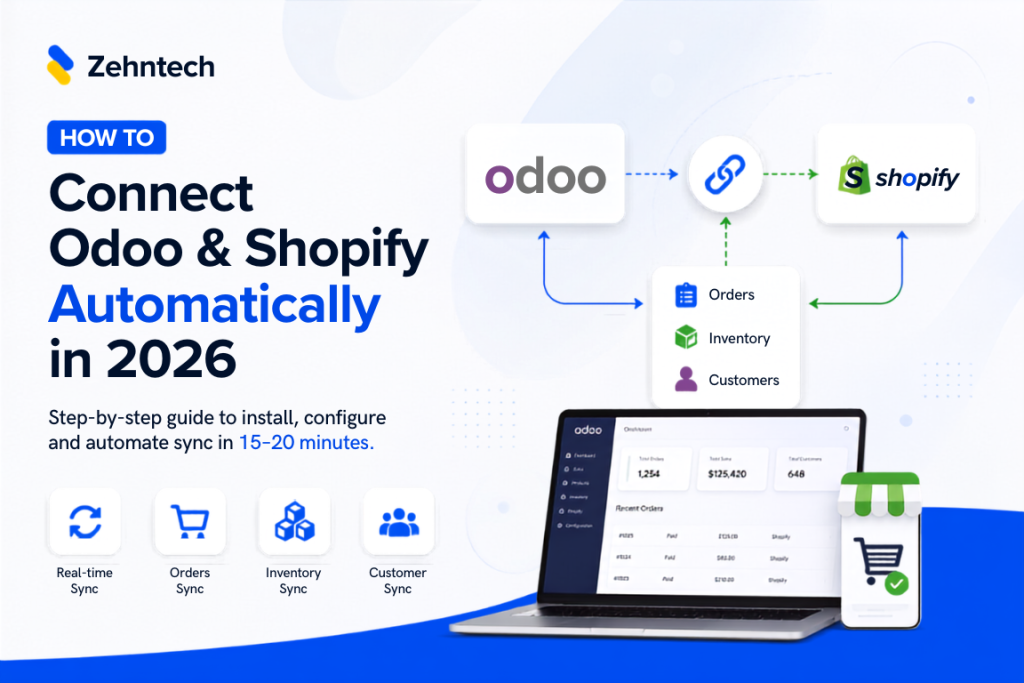
Connect Odoo & Shopify Automatically in 2026
How to Connect Odoo and Shopify Automatically (2026 Guide)
If you're running Shopify for your storefront and Odoo for everything behind it — inventory, accounting, fulfillment — you already know the two don't talk to each other out of the box. This guide walks through exactly how to connect them so orders, stock, and customer data sync automatically, with
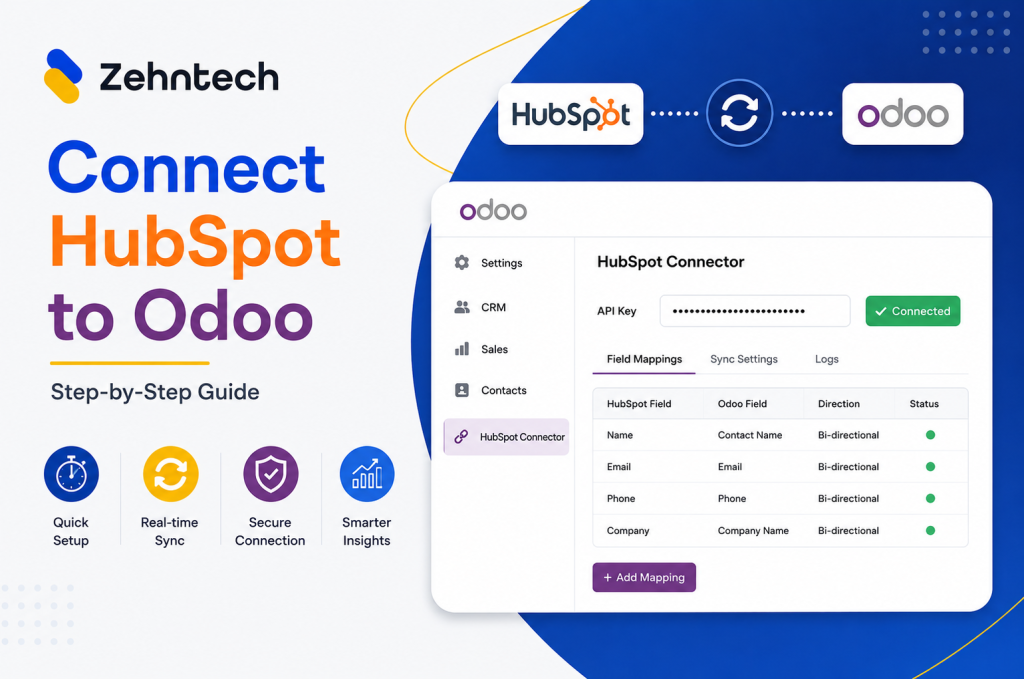
Odoo Hubspot Connector
How to connect hubSpot to odoo a step-by-step setup guide
This guide walks you through connecting HubSpot to Odoo using the Zehntech Odoo HubSpot Connector from generating your API key in HubSpot to your first live sync. Most teams complete this in under 10 minutes. Prerequisites Before you begin: Odoo version: v16, v17, v18 or v19 (Online, Odoo.sh or On-Premise)

          Success!!

          Keep an eye on your inbox for the PDF, it's on its way!

          If you don't see it in your inbox, don't forget to give your junk folder a quick peek. Just in case.


              You have successfully subscribed to the newsletter

              There was an error while trying to send your request. Please try again.

              Zehntech will use the information you provide on this form to be in touch with you and to provide updates and marketing.