


Automate Marketing Initiatives with Salesforce Marketing Cloud Learn More

WooCommerce: What Does It Have To Offer Your Online Store?

Online stores have become a fashion today. In this era, if you want your products to sell at a large scale, an online store is what you must have. People today have become very tech-savvy. This, when combined with their hectic lives, leaves them with little time and energy to hunt out for the products they want and need in the traditional market. They prefer to look out for things online, purchase them from there, and get the items home-delivered. This is easier, and it also offers people with more options to choose from. So, in this growing, competitive business environment, where it gets difficult for you to sell your products, an online store will do the vice-versa for you. Not only will it help you easily sell your products, but it will make you scale many times by reaching a larger audience. And you can create this store with a simple WordPress plugin called WooCommerce.

What is WooCommerce?

WooCommerce is a WordPress plugin supported by Automatic, which you can use to create an online ecommerce store on your existing WordPress website. It has the capabilities to scale your online store and increase its attractiveness and functionality by many times with the number of features and extensions that it has to offer.

Why is WooCommerce a Good Choice?

Although there are many tools and plugins that you can use to create and run your ecommerce store or website, WooCommerce shall be your best take for the following reasons. 

  1. WooCommerce is Easy and Understandable
    Using technology for running your business never means that you want to get into complexities of that technology. You look for something that is easy to use and understand, and you be able to run it without much difficulty or external help. WooCommerce is just the solution. It is very easy to install and setup. All you have to do to use WooCommerce on your website and create your own online store is install the WooCommerce plugin from the plugin directory of WordPress and set it up following the instructions in the inbuilt setup wizard. Once you are done with the installation and set up, you are good to go and run your online store.
  2. WooCommerce has Extensions that Provide Added Functionalities
    WooCommerce plugin adds functionalities such as product management, cart management, and payment management to your online store. Along with that, you can extend its functionality as much as you want using different themes, plugins, and extensions. This means that the WooCommerce plugin has further plugins and extensions with which you can have additional features such as sending automated emails to the customers, providing invoices, adding additional menus, providing filters to make the search easier for your customers, and many more things. Adding such features to your store enhances the user experience and generates more traffic for your store. And more traffic when combines with good user experience simply mean better sales.
  3. WooCommerce is Open-Source and Free
    What else do you need? WooCommerce is something that gives you the benefits of a premium service for free. It is easy, it is understandable, even by a layman, and it has a plethora of features to give you. And all this is for free. That is one of the biggest advantages of the plugin. Although you may need to pay for some of the features at a later stage, getting anything that is beneficial at such professional level for free is surely an ad on.

So, this is what WooCommerce has to offer you. And with all these things, it has become an obvious choice for creating an online store. So, go for it and scale-up. 

A place for big ideas.

Reimagine organizational performance while delivering a delightful experience through optimized operations.

Top Stories

The Complete Guide to Odoo in 2026
The Complete Guide to Odoo in 2026: Implementation, Customisation, Integration, Migration and Cost
What Odoo actually is Odoo is a suite of business applications built on a shared database — CRM, sales, inventory, manufacturing, accounting, HR, website, point of sale, and several dozen more. The applications are modular. You switch on the ones you need and leave the rest off. The architectural point
How to Connect WooCommerce to Odoo
How to Connect WooCommerce to Odoo — Complete Setup Guide
Connecting WooCommerce to Odoo does not require a developer, a middleware tool, or weeks of implementation. The Zehntech Odoo WooCommerce Connector gives you real-time bi-directional sync between your WooCommerce store and your Odoo backend — set up in under 15 minutes. This guide is for Odoo administrators, eCommerce operations managers,
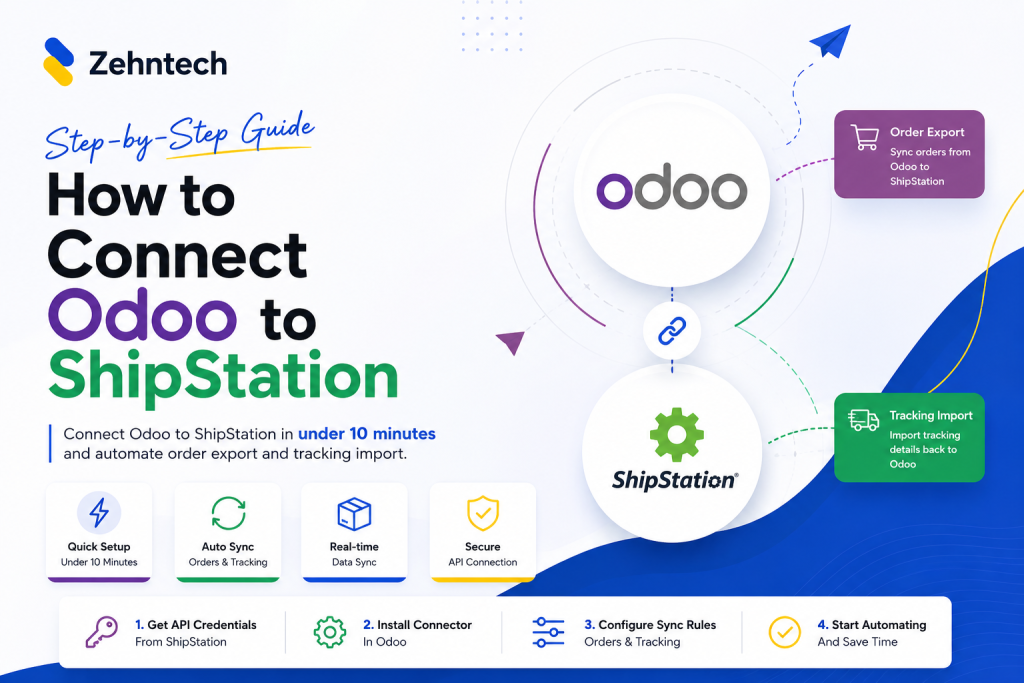
How to Connect Odoo to ShipStation — Step by Step Setup Guide
How to Connect Odoo to ShipStation A Step-by-Step Setup Guide
This guide walks you through connecting Odoo to ShipStation using the Zehntech Odoo ShipStation Connector — from generating your API credentials in ShipStation to your first automated order push and tracking import. Most setups take under 10 minutes. Prerequisites Before you begin: Odoo version: v17, v18 or v19 (Online, Odoo.sh
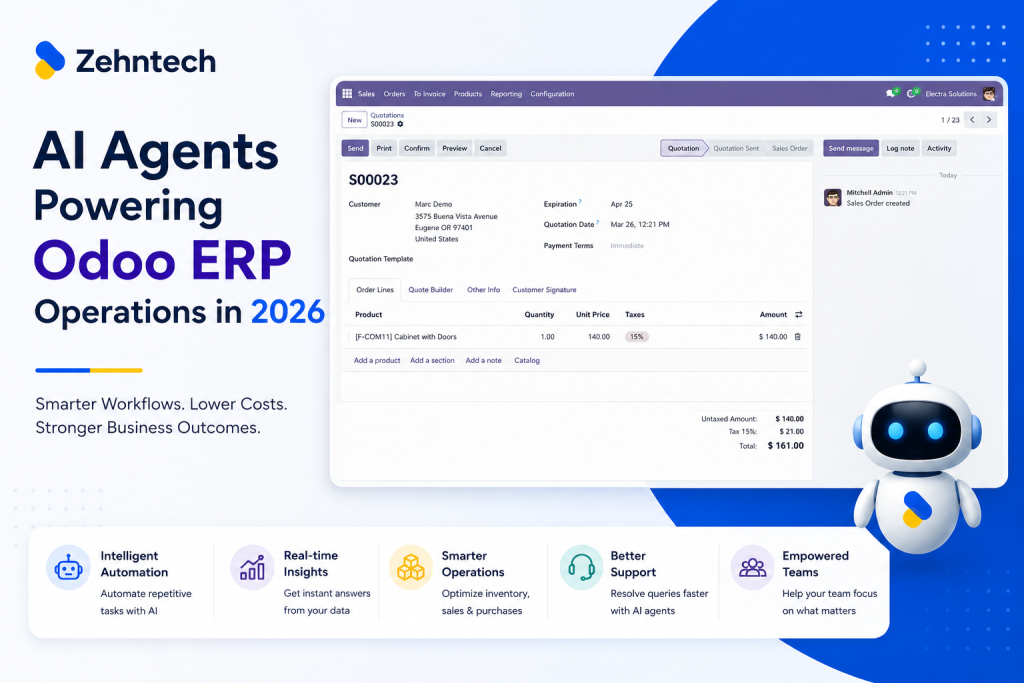
AI Agents Are Transforming Odoo ERP Operations in 2026
How AI Agents Are Transforming Odoo ERP Operations in 2026
Most ERP systems already hold the information needed to make better decisions. The problem is the work between the data and the decision: opening several modules, filtering records, exporting spreadsheets, comparing numbers and then updating Odoo manually. AI agents are beginning to remove that gap. Unlike a chatbot that only
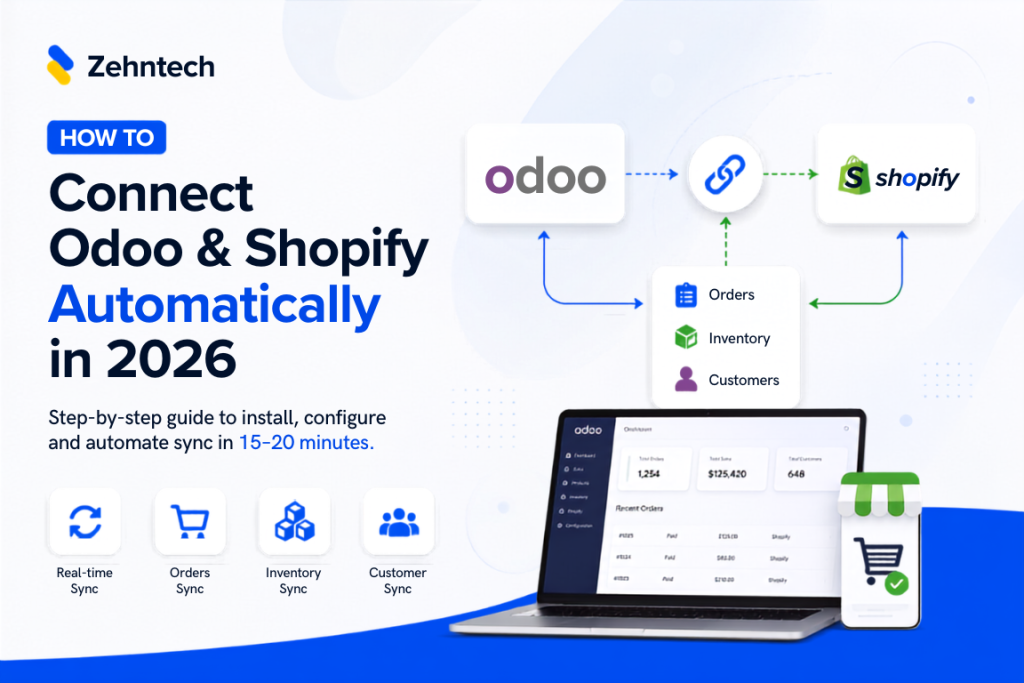
Connect Odoo & Shopify Automatically in 2026
How to Connect Odoo and Shopify Automatically (2026 Guide)
If you're running Shopify for your storefront and Odoo for everything behind it — inventory, accounting, fulfillment — you already know the two don't talk to each other out of the box. This guide walks through exactly how to connect them so orders, stock, and customer data sync automatically, with
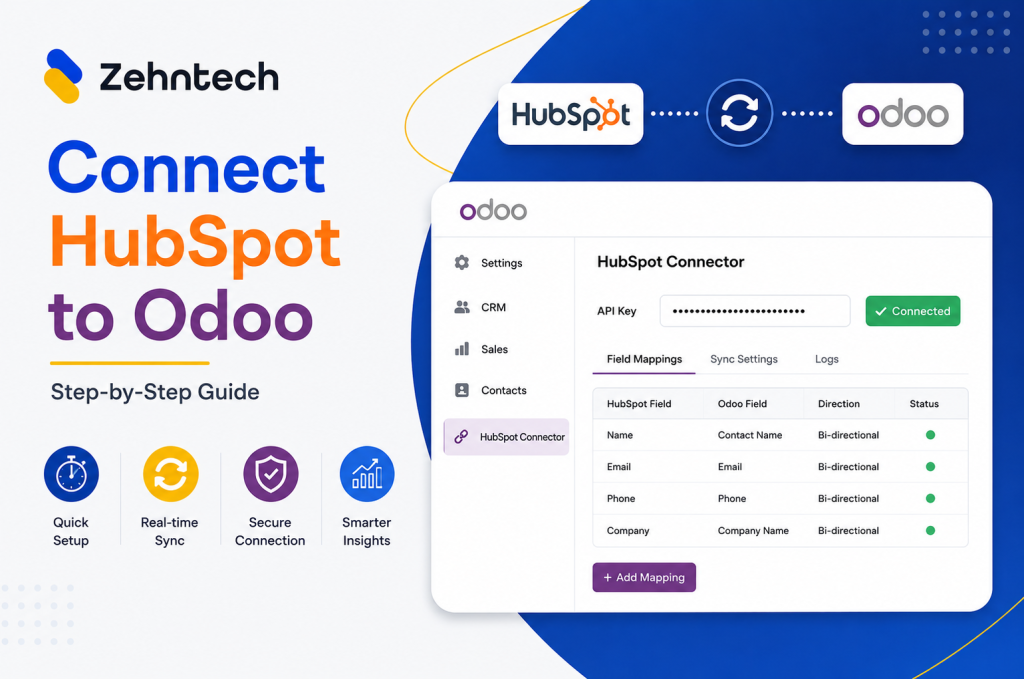
Odoo Hubspot Connector
How to connect hubSpot to odoo a step-by-step setup guide
This guide walks you through connecting HubSpot to Odoo using the Zehntech Odoo HubSpot Connector from generating your API key in HubSpot to your first live sync. Most teams complete this in under 10 minutes. Prerequisites Before you begin: Odoo version: v16, v17, v18 or v19 (Online, Odoo.sh or On-Premise)

          Success!!

          Keep an eye on your inbox for the PDF, it's on its way!

          If you don't see it in your inbox, don't forget to give your junk folder a quick peek. Just in case.


              You have successfully subscribed to the newsletter

              There was an error while trying to send your request. Please try again.

              Zehntech will use the information you provide on this form to be in touch with you and to provide updates and marketing.