



Join us at GITEX 2025! Discover our solutions at Hall 4, Booth H-30 Schedule a Meeting Today.
Automate Marketing Initiatives with Salesforce Marketing Cloud Learn More
Join us at GITEX 2024! Discover our solutions at Hall 4, Booth H-30 Book your live demo today.

Magento Migration: Not Only Favorable But a Necessity

Ever since Magento came up with its new release of Magento 2.0 in 2015, Magento migration has been a hot topic in the e-commerce world. And what has hyped the discussion is the recent announcement of Magento regarding support for Magento 1. It is official now that Magento will withdraw its support for Magento 1 in June 2020, and this announcement has no more left it just favorable to migrate. Instead, now you need to necessarily migrate to Magento 2 unless you want to go through the hassles of not having official support for the functioning of your website. Moreover, migration to the updated and latest version of the platform will provide you with additional benefits and abilities. Here is what you can get with Magento migration and what necessitates this migration for you.

Why should You Migrate to Magento 2.0?

  1. Security of Your Website  
    Security is crucial for any e-commerce website. There is enormous customer data which needs to be protected. The customers need to be assured that the data they are giving out and the transactions they are making are absolutely secure. So, security is at the priority for every e-commerce website. However, you will no longer be able to provide such security over Magento 1 once the support goes, because with the support will go the offerings of security patches. As soon as the security patches go, you can expect security breaches over your website, and you will not be able to get any help with that.  
    Migrating to Magento 2.0 is the absolute resolve for all of this. Not only will it support the security of your website, but it will make it better as well. 
  2. Maintaining Your Competitive Edge  
    With every business wanting to extend its local boundaries and come into the digital and global sphere, the competition in the e-commerce market is highly increasing. In such a competitive scenario, if you do not keep up with what is latest, you are sure to lose your competitive edge in the market. So, to match up the competition level, you need to migrate to Magento 2.0 so that you keep enjoying the innovations that keep happening over Magento.
  3. Better Performance  
    A new version means new features, which means enhanced performance. Magento 2.0 has many new features which substantially enhance its performance. It has better and faster add-to-cart functionalities and response time. It has easier and quicker checkout options. It is also more mobile-friendly than Magento 1. Moreover, Magento 2 has been developed with an improved user interface, which offers a lot better user experience. With all these things, the performance of your website can highly scale.

Also Read:
Magento 1 Support Ending From June 2020
Magento 2.3 Feature – Made things Smarter for E-commerce

Magento 2.3 1024x683 1

With all these reasons, migration to the newer version is beneficial for you as Magento 2.0 is far more superior to the older version. Moreover, the security threats and competition drawback that you will face with sticking to the older version do not leave you a choice but to migrate. And the sooner you get done with that, the sooner you will be ready to start gaining from the advantages.  

Frequently Asked Questions (FAQs)
  1. What will be the best time for me to migrate to Magento 2.0?  
    Migrating to Magento 2.0 is no longer a choice. If you want to keep your website and online store functional and competitive, you need to migrate to the newer version. And it will be best for you to do it at the earliest so that you stay ready and equipped when the support for Magento 1 goes.
  2. How much time will it take to migrate my website?  
    It does not take much time to migrate a website from Magento 1 to Magento 2. However, the exact time frame cannot be a standard one. It depends on your store, its size, your needs, and expectations. You can get to know a predictable time frame from discussion with an experienced Magento developer.  

A place for big ideas.

Reimagine organizational performance while delivering a delightful experience through optimized operations.

Top Stories

Step-by-step guide to setting up Manufacturing Gantt Scheduling in Odoo — Zehntech
How to Set Up Manufacturing Gantt Scheduling in Odoo — Step-by-Step
Manual exports can work — for very small teams with low-frequency reporting needs. If your team reports monthly, uses a single Odoo module, and has an analyst with spare time, a manual export process is adequate. But for most Odoo teams reporting weekly or more frequently, there is a measurable
Odoo shopify connector
Best Shopify Odoo Connectors in 2026 — What Actually Works
If you are looking for a Shopify Odoo connector in 2026, you have three realistic paths: install a dedicated connector from the Odoo App Store, commission custom development, or continue running manual data entry between platforms. Each option has a legitimate use case. This article compares all three honestly —
Odoo shopify connector
Odoo Shopify Connector vs. Manual Data Entry — Which Is Right for Your Business?
Manual exports can work — for very small teams with low-frequency reporting needs. If your team reports monthly, uses a single Odoo module, and has an analyst with spare time, a manual export process is adequate. But for most Odoo teams reporting weekly or more frequently, there is a measurable
Odoo Power BI connector
Odoo Power BI Connector vs. Manual Data Exports: Which Is Right for Your Business?
Manual exports can work — for very small teams with low-frequency reporting needs. If your team reports monthly, uses a single Odoo module, and has an analyst with spare time, a manual export process is adequate. But for most Odoo teams reporting weekly or more frequently, there is a measurable
Odoo Power BI connector
How to Connect Odoo to Power BI — Complete Setup Guide
Connecting Odoo to Power BI does not require a consultant or a custom development project. The Zehntech Odoo Power BI Connector handles the hard parts — authentication, schema management, scheduled sync — so you can focus on building dashboards.This guide is for Odoo administrators and IT implementers connecting Odoo to
Odoo Shopify connector
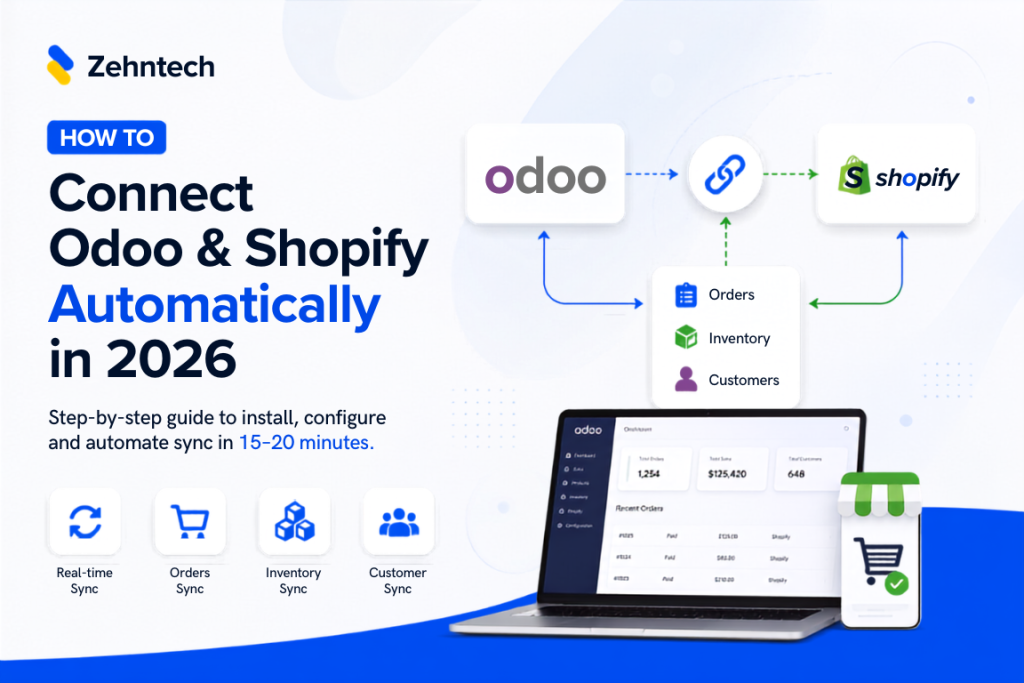
How to Connect Shopify to Odoo — Complete Setup Guide
Connecting Shopify to Odoo does not require custom development or a system integrator. The Zehntech Odoo Shopify Connector handles the authentication, data mapping, and sync logic — so you can focus on configuring which data to move, not how to move it.This guide is for Odoo administrators and IT implementers

          Success!!

          Keep an eye on your inbox for the PDF, it's on its way!

          If you don't see it in your inbox, don't forget to give your junk folder a quick peek. Just in case.


              You have successfully subscribed to the newsletter

              There was an error while trying to send your request. Please try again.

              Zehntech will use the information you provide on this form to be in touch with you and to provide updates and marketing.